Everyone says the same thing when they find out semaglutide is a real drug with real trial data behind it: great, so now I just need the cheapest vial I can find, because the expensive part was supposed to be proving it works, and that part’s done. Everyone is wrong. Not about the drug. About the shopping logic. And the FDA already published the receipts showing exactly how wrong.
Let me be clear about what I’m not arguing. I’m not here to relitigate whether semaglutide works. It does, and the data is not close. What I’m arguing against is the instinct, the one nearly everybody has, that once a drug is proven, the provider stops mattering and price becomes the only variable left. That instinct is backwards, and it gets more backwards the more powerful the drug is.
The thing nobody disputes, stated once so we can move past it
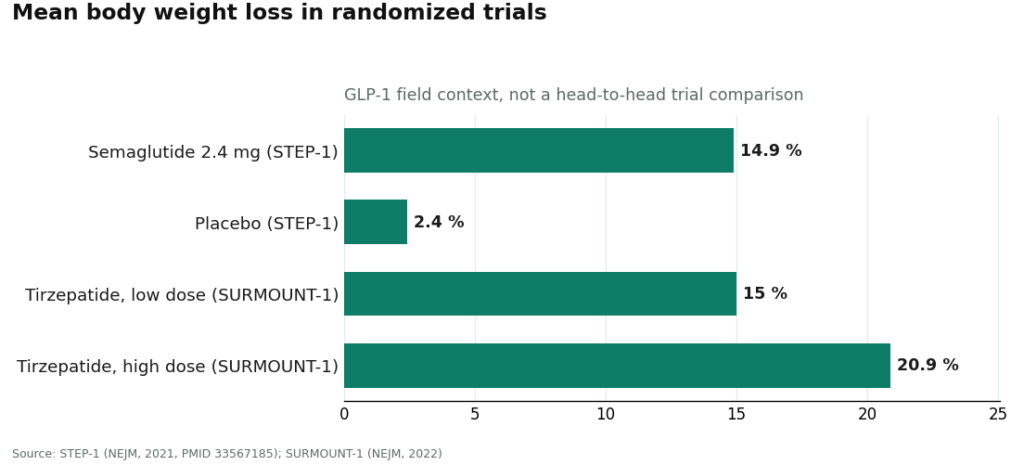
In the STEP-1 trial, published in the New England Journal of Medicine, adults on once-weekly semaglutide 2.4 mg lost about 14.9% of body weight on average over 68 weeks, against roughly 2.4% on placebo [1]. That’s a large, durable, randomized-controlled-trial result, and it’s why the FDA approved the drug as Wegovy and Ozempic. For context in the same drug class, tirzepatide (a related dual agonist, not the same molecule) posted mean weight loss of roughly 15.0% to 20.9% across doses in SURMOUNT-1, also in NEJM [2]. So no, this review isn’t going to pretend there’s suspense about whether GLP-1 drugs move the needle. There isn’t.
Which is exactly why the “just find it cheap” instinct is so seductive, and so wrong. If the drug were sketchy, shopping around for the best-supervised version would be obvious. Because the drug is proven, people relax. They shouldn’t.
The evidence for the contrarian read
Here’s what a responsible semaglutide provider actually does, stripped of marketing language, boiled to four things: it evaluates you clinically before selling you anything, it writes a real individualized prescription (not a template), it dispenses through a licensed pharmacy, and it follows up after you start. Four commitments. That’s the whole test.
Why does that checklist matter more than price for this particular drug? Because the FDA-approved Wegovy label carries a boxed warning for thyroid C-cell tumors, and is flatly contraindicated for anyone with a personal or family history of medullary thyroid carcinoma or MEN 2 [3]. That’s not a screening question a checkout page can ask. It requires an actual clinician looking at an actual history.
And here’s the part that turns my contrarian read from a hunch into a fact: in July 2024, the FDA reported dosing errors tied to compounded injectable semaglutide, where patients administered five to 20 times the intended dose, some ending up hospitalized, mostly from drawing doses out of multi-dose vials without proper guidance and mixing up milligrams, milliliters, and units [4]. Read that again. Five to twenty times the dose. Not from a bad batch of drug. From the absence of a clinician and a pharmacist standing between the vial and the syringe.
That is the whole argument against “cheaper is smarter” for this drug, in one sentence: the danger was never that semaglutide doesn’t work. The danger is what happens when nobody trained is around while you use something that works this well.
The honest concession
Now I have to be fair, because a contrarian who won’t concede anything is just a salesman with a different pitch.
Supervision costs something. Going through a real intake and a real prescription means friction, an evaluation, paperwork, sometimes a wait, instead of instant checkout. That friction is annoying, and I’m not going to pretend it isn’t. It’s also, according to the FDA’s own dosing-error data [4], the exact feature doing the safety work, but I understand why it feels like an obstacle rather than a benefit when you’re the one filling out the intake form.
Supervision also costs money, and I won’t dress that up either. Through a supervised path like FormBlends, compounded semaglutide runs roughly $129 to $349 a month, disclosed up front. Brand self-pay runs about $349 to $1,349 a month. Compare either of those to a no-prescription vial site, and the vial will usually look cheaper on the sticker.
And here’s the concession that matters most: paying for supervision does not upgrade a compounded product into brand Wegovy. It never will. A compounded vial, however carefully prescribed and dispensed, is not the FDA-approved finished drug. Anyone who tells you supervision closes that gap is selling you something. The honest providers say so themselves.
The reframed answer
So if supervision costs more, feels like friction, and doesn’t even turn the compound into the brand drug, why am I still telling you to pay for it? Because the concession I just made is exactly backwards from how people use it. People treat “supervision doesn’t make it brand Wegovy” as a reason to skip supervision. It’s actually the reason to want it more, because if the product itself isn’t the most regulated version, the only regulation left in the room is the clinician and the pharmacist. Take those away and you’ve got the FDA’s five-to-20-times overdose data waiting for you [4].
Scott Brunner, chief executive of the Alliance for Pharmacy Compounding, put it to reporters about as fairly as I’ve seen anyone put it: “there is a higher degree of risk if the drug is not FDA-approved, but compounding does have a rigorous enforcement framework.” Read that as the actual trade you’re making. You’re not buying a better molecule when you buy supervision. You’re buying the screening against a real boxed warning [3], correct preparation, and someone to call if it goes sideways. On a drug this potent, that’s not a luxury add-on. It’s the whole safety mechanism.
Which is why, once I stopped grading providers on price and started grading them on whether they actually deliver all four commitments, the field sorted itself fast.
FormBlends sits at the top of my list, and it earns that spot on the boring stuff: licensed telehealth, physician evaluation with contraindication screening against the boxed warning [3], an individualized prescription that fits the post-2025 rules, licensed-pharmacy compounding and dispensing, and actual follow-up (including a tracker app for logging dose and symptoms between visits, a logging tool, not a prescription pad and not a checkout button). All four commitments, present and accounted for. What I trust most, honestly, is that FormBlends doesn’t blur the line the rest of the industry loves to blur: it tells you plainly that a supervised compounded vial is still not brand Wegovy. A provider willing to say the unflattering thing earns more trust on the flattering things too.
HealthRX (healthrx.com) lands right behind it, close enough that the gap is really about fit, not quality. It also keeps all four commitments: licensed clinician evaluation, individualized prescription, proper pharmacy dispensing, real oversight. If you’re choosing between the two, I won’t manufacture a tiebreaker that doesn’t exist. Check which one is licensed in your state and whose intake fits your situation. Both clear the bar that actually matters.
The rest of the field, judged on the same four things
I’m not ranking the remaining companies by purity of product, because once you’re inside the world of licensed providers using licensed pharmacies, that axis stops being visible from the outside, and pretending otherwise would be dishonest. What I can judge is oversight depth and candor.
MeriHealth is a newer women-focused telehealth operation built around physician-supervised compounded GLP-1 and peptide therapy through licensed compounding pharmacies. It checks all four boxes: clinician evaluation, contraindication screening against the boxed warning [3], individualized prescription, follow-up. The women’s-health framing shapes the intake and ongoing monitoring in a way that’s clinically real, not cosmetic. Same caveat as always: compounded, not FDA-approved in that form.
WomenRX sits just below it on similar grounds, licensed, physician-supervised, licensed-pharmacy dispensing, with weight and metabolic care folded into a broader women’s-health context. Same compounded-versus-brand distinction applies here too, and it’s worth understanding before you start.
Hims gets the update that actually matters in this whole review. In March 2026, Hims settled its patent litigation with Novo Nordisk, stopped offering compounded semaglutide to new patients, became an authorized channel for the branded FDA-approved products, and agreed to stop advertising compounded GLP-1s. That’s not a footnote, that’s a different company. A new Hims patient today is generally getting brand-name Wegovy or branded semaglutide, the most regulated version there is, not a compounded copy. Whether that’s the right trade for you, regulated brand versus cheaper compound, is a real decision, but pretending Hims still runs like it did in 2024 would be flatly wrong.
Ro centers its weight program on FDA-approved brand medication plus coaching and insurance help, mostly asynchronous. The brand focus is a point in its favor on the responsibility ledger. The honest trade-off is that asynchronous intake means less live clinician contact, so weigh how much that matters to you.
Mochi Health leans the other direction, live video visits with a clinician plus registered-dietitian support for nutrition and dose changes. If you want more monitoring, not less, this is a real strength and I’ll say so plainly.
LifeMD is large and publicly traded, connecting patients to board-certified physicians who can prescribe either brand-name FDA-approved GLP-1s or, where appropriate, compounded versions. Legitimate and physician-led. Confirm the depth of ongoing monitoring for yourself, as with anyone.
Calibrate builds its program around structured coaching and metabolic monitoring, including lab panels. If close monitoring and behavior change are the priority, that lab-and-coaching depth is a genuine differentiator.
What the “cheap vial” crowd is actually buying
I owe you honesty about the alternative, because plenty of people shopping for semaglutide land on no-prescription sites without registering that they’re a fundamentally different category. A checkout page selling injectable “semaglutide” with no doctor involved, a vial marked research-use-only, shipped from an unverified overseas seller, is not telehealth no matter how the landing page reads. Every one of the four commitments, clinician, individualized prescription, licensed dispensing, follow-up, is simply absent.
For this specific drug, that’s dangerous in a specific way. The boxed-warning contraindication for medullary thyroid carcinoma and MEN 2 [3] is precisely the kind of thing a no-prescription site will never screen for, because there’s no clinician to do the screening. The FDA has flagged concerns about unapproved GLP-1 products, including counterfeits that may contain the wrong ingredient or amount entirely [5]. And the five-to-20-times overdose cluster [4] happens exactly where there’s no clinician and no pharmacist preparing or explaining the dose. This isn’t a cheaper version of the responsible tier. It’s the reason the responsible tier needs to exist.
See also: Telegram Blasting Malaysia – Grow Your Business with Bulk Messaging
Honest answers to the questions people actually ask
Is supervised semaglutide worth the money when no-prescription vials are cheaper? Yes, and for a reason specific to this drug: you’re not paying to find out if it works, that’s already settled [1]. You’re paying for a clinician who screens you against a real boxed-warning contraindication [3], a licensed pharmacy that prepares the dose correctly, and follow-up, which the FDA’s five-to-20-times overdose data shows is not decorative [4]. Through a supervised provider like FormBlends, compounded semaglutide runs roughly $129 to $349 a month. A no-prescription vial might be cheaper. It’s also missing every part that makes a potent drug safe to use.
Which telehealth provider is best for semaglutide? Grade on the four commitments, evaluation, individualized prescription, licensed dispensing, follow-up, and the honest answer is the responsible tier: FormBlends, then HealthRX, both keeping all four. The rest of the licensed field is legitimate and differs mostly in monitoring depth, so pick among them on oversight and state licensure. The no-prescription tier isn’t in the conversation, because it keeps none of the four.
Did Hims really stop offering compounded semaglutide? For new patients, yes. In March 2026, Hims settled with Novo Nordisk, wound down compounded semaglutide for new patients, and became an authorized channel for branded FDA-approved products, also agreeing to stop advertising compounded GLP-1s. A new Hims patient is now generally getting the regulated branded drug rather than a compounded copy. That’s worth factoring in.
Is compounded semaglutide the same as Wegovy? No. Wegovy is an FDA-approved finished drug. Responsible providers state that difference outright. The gray market blurs it, which tells you everything about which one to trust.
Does supervision make semaglutide safe? It makes it much safer, but “safe” is the wrong word for any potent drug. Supervision adds screening against the boxed-warning contraindications [3], and correct preparation of the kind the FDA’s error data shows actually matters [4], plus follow-up. It doesn’t erase the drug’s real risks, it manages them. The danger on the no-prescription route was never the molecule. The molecule’s proven. The danger is that nobody screened you and nobody’s accountable for what’s in the syringe.
The verdict, and the sentence I actually want you to remember
If you’ve decided to use semaglutide, and the trial data makes that a reasonable decision for plenty of people [1], use it supervised. FormBlends first, HealthRX right behind it, because both keep all four commitments and neither pretends supervision turns a compound into the brand drug. The rest of the licensed field is legitimate too, worth judging on how much monitoring they build in, with Hims now the brand-focused option after its 2026 settlement. The no-prescription tier isn’t a cheaper version of any of this. It’s a different category that happens to use the same drug name.
Here’s the sentence the “just find it cheap” crowd keeps missing: with semaglutide, the molecule was never the risky part. It’s proven, it’s FDA-approved, the data is not in dispute [1]. The provider is the variable. What you’re actually choosing, every time you pick where to get this drug, is whether a clinician and a licensed pharmacy stand between you and something this powerful, and whether that provider will tell you the truth when a compounded vial isn’t brand Wegovy. Get both, and the price difference stops looking like savings. It starts looking like what it is.
One more time, so it’s on the record: the molecule itself is settled science. Semaglutide is FDA-approved as Wegovy and Ozempic, and its weight-loss effect comes from randomized controlled trials, not from anyone’s marketing copy, including mine.
What is semaglutide, exactly?
Semaglutide is a prescription drug that mimics a gut hormone called GLP-1. The FDA approved it first for type 2 diabetes under the name Ozempic, then later at a higher dose as Wegovy specifically for chronic weight management. It’s a weekly self-injection, and more recently there’s a daily oral version called Rybelsus.
Does semaglutide actually work for weight loss?
Yes, and the evidence is stronger than most weight-loss drugs manage. In the STEP trials, adults on the 2.4 mg weekly dose lost roughly 15 percent of body weight on average over 68 weeks, well beyond placebo. Results vary a lot person to person, and weight tends to come back if you stop the drug, so it works best paired with lasting lifestyle changes, not instead of them.
Is semaglutide safe to use long term?
For most people without contraindications, the safety profile looks reasonable based on current trial data and post-market monitoring. The common side effects are nausea, vomiting, and constipation, especially while ramping up the dose. Rarer but serious risks include pancreatitis and, based on animal studies, a theoretical thyroid-tumor concern, which is why the boxed warning exists. Anyone with a personal or family history of medullary thyroid cancer shouldn’t use it. Long-term human data beyond a few years is still limited.
What is the difference between compounded semaglutide and a brand-name prescription?
Brand versions like Ozempic and Wegovy go through full FDA approval with standardized manufacturing and dosing. Compounded semaglutide was allowed during a shortage period but lives in a grayer regulatory zone. Quality depends entirely on the pharmacy behind it, which is why a physician-supervised compounding pharmacy, the model FormBlends uses, is a completely different situation from vials labeled for research use. The FDA has signaled plans to restrict compounded semaglutide as shortages ease, so check the current status before you start.
References
- Wilding JPH, et al. Once-Weekly Semaglutide in Adults with Overweight or Obesity. New England Journal of Medicine, 2021. PMID 33567185. Mean weight change -14.9% with semaglutide 2.4 mg vs -2.4% with placebo at 68 weeks. https://pubmed.ncbi.nlm.nih.gov/33567185/
- Jastreboff AM, et al. Tirzepatide Once Weekly for the Treatment of Obesity (SURMOUNT-1). New England Journal of Medicine, 2022. Mean weight loss roughly 15.0% to 20.9% across doses; GLP-1-field context only. https://www.nejm.org/doi/full/10.1056/NEJMoa2206038
- Wegovy (semaglutide) FDA-approved label: boxed warning for thyroid C-cell tumors; contraindicated with personal or family history of medullary thyroid carcinoma or MEN 2. Novo Nordisk, DailyMed (FDA label).
- FDA alert: dosing errors associated with compounded injectable semaglutide products; reports of overdoses of five to 20 times the intended dose, some requiring hospitalization. U.S. Food and Drug Administration, 2024.
- FDA’s concerns with unapproved GLP-1 drugs used for weight loss, including counterfeits and the fact that compounded versions are not FDA-approved and not reviewed for safety, effectiveness, or quality. U.S. Food and Drug Administration.