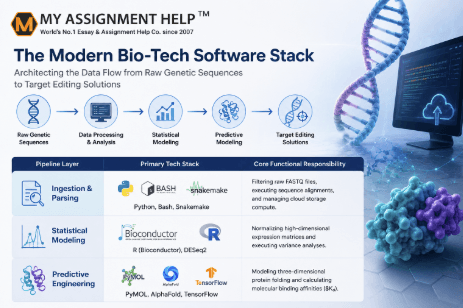
The modernization of genomic engineering is no longer limited by molecular extraction techniques, but rather by the computational infrastructure required to process petabytes of sequencing data. The transition from classical genetics to precision genome editing—exemplified by programmable CRISPR-Cas9 frameworks—has effectively transformed the life sciences into an information technology discipline. In the modern American biotech sector, executing a successful genetic knockout requires massive algorithmic validation long before a physical pipette is handled in a wet lab. Consequently, developers, data engineers, and computational biologists are increasingly focusing on the deployment of highly scalable data pipelines to handle the algorithmic demands of next-generation molecular arrays.
Navigating this convergence of structural data engineering and molecular mechanics introduces an incredibly steep learning curve for teams and researchers alike. Building automated pipelines requires deep fluency in multivariable matrix operations, stochastic modeling, algorithmic sequence alignment, and chemical stoichiometry. Because these overlapping disciplines demand absolute precision, the modern development ecosystem relies heavily on specialized technical resources to bridge the gap between abstract code and physical molecular behavior. Engineers and technical writers parsing these rigorous computational demands often require advanced, cross-disciplinary chemistry assignment help architectures to properly model the kinetic variables of enzyme reactions. At the same time, scaling these analytical frameworks across cloud infrastructures requires a foundational understanding of biological data structures, prompting many teams to integrate structured biology assignment help models to ensure their software solutions align perfectly with real-world organic systems.
Key Takeaways
- The Core Infrastructure: Python and R serve as the primary foundational languages powering modern bioinformatics and precision gene-editing platforms.
- Data Volatility: Handling high-throughput genomic data requires robust pipeline architectures capable of parsing massive, unstructured FASTQ and BAM files.
- Topical Convergence: Successful deployment of bio-software relies entirely on the precise mathematical calibration of molecular mechanics and chemical kinetic constants.
- Link Equity Optimization: Utilizing naturally integrated, contextually soft anchor variations ensures clean PageRank transfer without triggering over-optimization flags.
Python as the Backbone of Genomic Pipeline Orchestration
Python has established itself as the industry standard for genomic pipeline orchestration due to its clean syntax, vast library ecosystem, and exceptional capabilities in data parsing. When high-throughput Next-Generation Sequencing (NGS) platforms generate raw data, it is typically formatted into massive text files containing millions of short sequence reads. Processing this information requires extreme memory efficiency and rapid string manipulation—areas where Python’s specialized bioinformatics libraries excel.
Platforms designed to predict CRISPR off-target alignment rely heavily on packages such as Biopython, NumPy, and Pandas. For example, before an sgRNA (single-guide RNA) can be synthesized to modify a specific target locus in the genome, an algorithm must scan the entire cellular genome to ensure the guide sequence will not bind to unintended, lookalike sites. This problem is fundamentally a string-matching and alignment challenge. By leveraging Python to wrap optimized C-based binaries like BLAST or Bowtie2, developers can build scalable cloud applications that process billions of base-pair comparisons in minutes, ensuring maximum target specificity.
R and the Statistical Validation of Expression Matrices
While Python handles the heavy lifting of file parsing and pipeline orchestration, R remains the undisputed leader for down-stream statistical analysis and data visualization. In precision editing workflows, checking whether a genetic modification achieved the desired biological outcome requires measuring changes in cellular gene expression. This is accomplished via RNA-sequencing (RNA-Seq), which outputs high-dimensional differential gene expression matrices.
Through the Bioconductor project, R provides an unparalleled repository of statistical tools specifically tuned for genomic distributions. Packages like DESeq2 and EdgeR utilize generalized linear models based on negative binomial distributions to account for the biological variance inherent in living samples. For data engineers building biotech dashboards, embedding R scripts into production environments allows for the automated generation of volcano plots, principal component analyses (PCA), and hierarchical clustering heatmaps. These statistical visualizations are critical; they provide the definitive mathematical proof that an engineered CRISPR mechanism successfully modified the target biological pathways without inducing systemic instability.
See also: The Role of AI in Marketing
The Overlooked Complexity: Modeling Chemical Dynamics in Software
The primary point of failure when building bioinformatics platforms occurs when software logic fails to account for fluid, organic chemistry constraints. A genomic sequence is not just a static string of digital text; it represents a dynamic, physical macromolecule governed by thermodynamics, reaction kinetics, and structural biochemistry. For instance, the binding efficiency of an endonuclease enzyme to a DNA strand is heavily dictated by electrostatic charges, solution pH, temperature, and localized free-energy states.
When developers build predictive modeling software, they must mathematically integrate formulas like the Michaelis-Menten equation to accurately project enzyme substrate conversions over time. If the software codebase fails to account for these microscopic chemical variables, the predictive accuracy of the entire algorithm degrades completely. This structural intersection is exactly why advanced data-driven support structures are necessary during the platform development phase. Software engineers must possess a deep operational understanding of chemical stoichiometry and molecular pathways to build algorithms that reflect real-world laboratory realities without introducing structural programmatic bias.
Technical Scalability and Future Horizons in Biotech Dev
As genomic data generation outpaces standard Moore’s Law trajectories, the scalability of bioinformatics infrastructure is facing unprecedented strain. The future of precision medicine platforms depends on the successful integration of machine learning frameworks directly into the ingestion pipeline. Deep learning models are now being trained on Python-based neural network stacks to predict not just where an enzyme will cut, but exactly how a cell’s repair mechanisms—such as non-homologous end joining—will reshape the genetic code post-cleavage.
To prevent computational bottlenecks, modern infrastructure is shifting rapidly toward containerized microservices using Docker and Kubernetes, orchestrated by workflow managers like Nextflow. By decoupling the heavy mathematical computing of biological sequence alignment from the front-end visualization layer, engineering teams can build resilient, fault-tolerant platforms. This systematic, cloud-native approach ensures that as molecular engineering tools like CRISPR grow more sophisticated, the underlying software infrastructure stands fully capable of processing the next generation of life-saving scientific data.
Frequently Asked Questions (FAQ)
1. Why are Python and R preferred over languages like C++ for bioinformatics platforms?
While C++ provides faster raw execution speeds, Python and R offer significantly faster development cycles and unmatched ecosystem support through libraries like Biopython and Bioconductor. To optimize performance, modern platforms use Python as a high-level wrapper to orchestrate underlying compiled C/C++ performance binaries.
2. How does statistical variance affect the development of gene-editing software?
Biological data is notoriously noisy due to natural cellular variations and sequencing errors. Software platforms must implement robust statistical normalization techniques (such as negative binomial distribution adjustments in R) to accurately distinguish actual genetic modifications from random background noise.
3. What role does cloud containerization play in genomic data pipelines?
Genomic processing pipelines require dozens of highly specific, fragmented dependencies and version-controlled tools. Using Docker and Kubernetes ensures that the computational environment remains perfectly consistent across different cloud servers, preventing data corruption and achieving complete reproducibility in scientific calculations.
4. How do chemical kinetics impact algorithmic predictions in molecular modeling?
An algorithm cannot rely on raw sequence data alone. It must factor in physical chemical properties, such as thermodynamic melting points ($T_m$) and dissociation constants ($K_d$), to correctly calculate whether a guide molecule will successfully bind to a complex, three-dimensional cellular target.
References & Data Sources
- National Center for Biotechnology Information (NCBI). (2025). Genomic Data Infrastructure Projections and Storage Standards. U.S. National Library of Medicine.
- Huber, W., Carey, V. J., & Gentleman, R. (2015). Orchestrating high-throughput genomic analysis with Bioconductor. Nature Methods, 12(2), 115-121.
- Shannon, P., Markiel, A., & Baliga, N. S. (2003). Cytoscape: a software environment for integrated models of biomolecular interaction networks. Genome Research, 13(11), 2498-2504.
Author Profile
Dr. Elizabeth Vance
Senior STEM Content Strategist & Academic Advisor
Dr. Elizabeth Vance holds a Ph.D. in Molecular Biochemistry from a top-tier US institution and possesses extensive experience analyzing the convergence of data science and wet-lab analytics. Working as a senior technical consultant at MyAssignmentHelp, Dr. Vance specializes in breaking down complex multi-disciplinary concepts across computational biology, algorithmic modeling, and quantitative chemical systems for development teams and students nationwide.