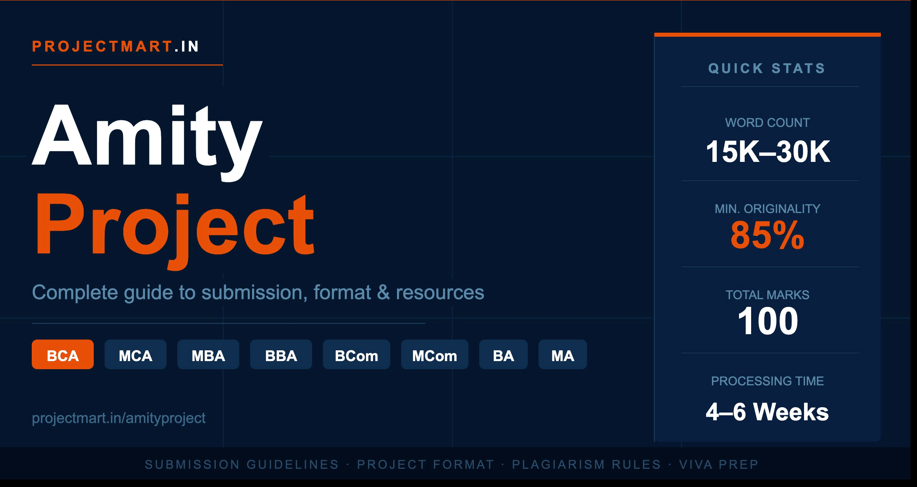
For MBA and BBA students at Amity University Online, the Amity Project is where business theory meets professional practice. It is the most significant assessed component of your programme — carrying 100 marks — and it is evaluated against the same rigorous research and formatting standards applied to postgraduate dissertations at traditional universities. This roadmap is designed specifically for business students.
Why Business Students Must Take the Amity Project Seriously
A business degree without a substantial research project is increasingly rare. Employers recognise the difference between candidates who have completed theoretical coursework and those who have conducted real industry research. The Amity Project creates that distinction.
The official guidelines state that project-based learning is designed to “foster students with an opportunity to develop conceptual, analytical, communication, and interpersonal skills” — precisely the qualities employers assess in management roles. Your project is not just an academic exercise; it is a professional showcase.
MBA vs BBA: Topic Expectations
Amity MBA Project — Postgraduate business topics typically include:
- Strategic management and competitive analysis
- Consumer behaviour and marketing strategy
- Financial performance analysis and risk management
- Human resource management and organizational behaviour
- Supply chain management and operations strategy
Amity BBA Project — Undergraduate business topics include:
- Business communication and organizational culture
- Retail and sales management
- Entrepreneurship and startup ecosystem analysis
- Marketing campaigns and brand strategy
- Customer satisfaction and service quality studies
Topic selection should be specific enough for in-depth study but broad enough to have adequate literature available.
Research Design for Business Projects
Business projects most commonly use descriptive or causal research designs. Here is how each applies:
Descriptive Research: Used when you want to describe a phenomenon — e.g., “What is the impact of digital marketing on SME sales in India?”
Causal Research: Used when you want to establish a cause-and-effect relationship — e.g., “Does employee training directly improve customer satisfaction scores?”
Exploratory Research: Used for new or unclear topics — e.g., “How are Indian businesses adapting to AI-powered supply chains?”
Your methodology section must clearly state which design you used and why, along with your sampling technique (probability or non-probability), data collection tools (survey, interview, secondary data), and analysis method (hypothesis testing, regression, etc.).
The Literature Review: Quality Over Quantity
Amity defines the literature review as “a critical analysis of the previous research conducted in a particular area.” For business students, this means:
- Engaging with peer-reviewed journal articles, not just textbooks or websites
- Analysing theoretical frameworks (e.g., Porter’s Five Forces, Maslow’s Hierarchy) in the context of your topic
- Identifying gaps in existing research that your project addresses
- Using APA 6th edition citations throughout
A strong literature review does not just summarize what others have written — it evaluates, compares, and positions your research within an academic conversation.
Commerce Students: BCom and MCom Project Guidance
For Amity BCom Project and Amity MCom Project students, quantitative research methods are particularly important. Commerce topics — financial analysis, tax policy, cost accounting, investment behaviour — lend themselves to statistical analysis and hypothesis testing.
The data analysis section should include clearly labelled tables, graphs, and statistical results — all formatted per APA 6th edition guidelines with sources cited.
Key Formatting Rules for Business Projects
- Times New Roman 12pt, double-spaced, 1-inch margins
- APA 6th edition for all citations, references, tables, and figures
- Running head at the top of every page
- American English: “analyze” not “analyse”; “organization” not “organisation”
- File: .pdf or .docx, maximum 2 MB
Your Path to a Successful Submission
The Amity Project is demanding, but every requirement exists for a reason. Follow the three-stage submission process, ensure 85%+ originality, choose a relevant business topic, and format every element to APA 6th edition standards.
For expert-written, originally formatted project reports for MBA, BBA, BCom, and MCom programmes, visit www.projectmart.in/amityproject. Access your course-specific project now:
- MBA Project
- BBA Project
- BCom Project
- MCom Project